
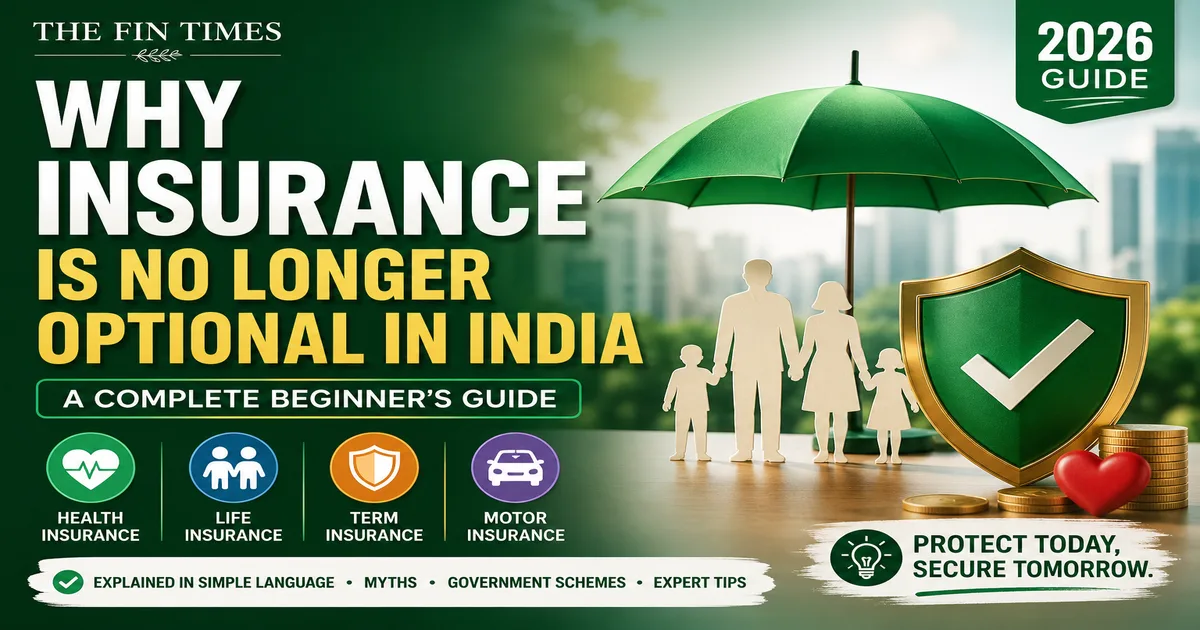
1. What Is Insurance? Let's Start From the Very Beginning
Let's be honest — most people buy insurance without fully understanding it. They sign papers, pay premiums, and hope they never actually need it. But that's not the right way to think about it.
In the simplest words: insurance is a contract between you and an insurance company. You pay a small, regular amount called a premium. In return, the company promises to pay a much larger amount if something bad happens to you — a medical emergency, an accident, the death of the breadwinner, or property damage.
Think of it like this. Imagine 1,000 people each putting ₹1,000 into a common pool every month. That's ₹10 lakh collected per month. If any one person in that group faces a ₹5 lakh hospital bill, the pool pays for it. Nobody can afford ₹5 lakh alone. But together, it is easy. That is what insurance is — a shared financial safety net.
Insurance vs. Savings — They Are Not the Same
- You build money slowly over time
- Available only what you've saved
- Takes years to accumulate ₹5 lakh
- Great for goals, not emergencies
- Gives you ₹5 lakh cover from Day 1
- Covers costs far beyond what you saved
- Low premium, high protection
- Designed exactly for emergencies
The biggest mistake families make is thinking "we have savings, we don't need insurance." But what if a medical emergency costs more than your entire savings? That is when insurance saves your family from financial ruin.
2. Why Every Indian Needs Insurance Right Now
India is changing fast — and not just economically. Healthcare costs are rising every single year. Road traffic has exploded. Nuclear families are replacing joint families, which means there is no extended support system during a crisis anymore. Here is why insurance is not optional in 2026:
The bottom line? In India today, a single hospitalisation without insurance can wipe out a family's entire savings of years. That is a reality, not a scare tactic.
3. Types of Insurance Every Indian Should Know
There are many types of insurance, but let's focus on the ones that actually matter for most families in India. You do not need all of them immediately — but you should understand what each one does.
Covers hospitalisation, surgeries, ICU, medicines. The single most important insurance for any Indian family. Get this first.
Pays a sum to your family if you pass away. Traditional endowment plans combine savings with insurance. Premiums are higher.
Pure protection. Low premium, very high cover (₹1 crore for ~₹1,000/month). Best for income earners with dependants.
Third-party motor insurance is legally mandatory under the Motor Vehicles Act. Comprehensive cover also protects your own vehicle.
Covers trip cancellation, lost baggage, medical emergencies abroad. A must for international travel. Costs very little.
Protects your home and belongings against fire, flood, theft, and natural disasters. Still underused in India despite growing risks.
4. Real Benefits of Having Insurance
People often think of insurance as money wasted if nothing bad happens. That thinking is completely wrong. Here is what insurance actually does for you:
- Financial security when it matters most: A ₹5 lakh health insurance policy means a ₹4 lakh surgery does not empty your bank account or force you to borrow money at high interest.
- Peace of mind every single day: Knowing your family is protected lets you sleep better. That psychological value is real and underrated.
- Tax benefits under Section 80D: Premiums paid for health insurance are deductible under Section 80D — up to ₹25,000 for self and family, and an additional ₹25,000–₹50,000 for parents.
- Cashless hospitalisation: With a good health insurance policy, you walk into a network hospital and get treated. The insurance company settles the bill directly. You do not have to arrange cash at midnight.
- Protection for your family's future: A term insurance policy ensures that even if the breadwinner is no longer around, the family can pay their rent, repay loans, and continue with their lives.
5. Common Mistakes People Make with Insurance
Most people who are underinsured are not uninformed — they just made a few classic mistakes. Avoid these:
- Buying insurance only for tax saving: Many people buy a policy in March just to show proof of investment. They end up with a low-quality plan that barely covers anything.
- Choosing the cheapest policy: The cheapest health plan often has a long list of exclusions, low room rent limits, and terrible claim support. Price matters, but coverage matters more.
- Not reading exclusions: Every policy has a list of things it does not cover. If you buy without reading these, you will get a nasty surprise when you actually need to claim.
- Depending only on employer health insurance: Your company's group health policy usually ends the moment you resign, are laid off, or retire. Always have your own independent health insurance policy. As ACKO's research shows, this is one of the most dangerous gaps in India's insurance awareness.
6. How to Choose the Right Insurance Plan
The insurance market in India has hundreds of plans. Here is a simple checklist so you do not get overwhelmed:
Always check the insurer's CSR — aim for 95%+ to ensure claims are actually paid when you need them.
Do not compare premiums in isolation. Compare what you get for that premium — room rent cap, sub-limits, exclusions.
Most health policies have 30-day to 4-year waiting periods for pre-existing diseases. Buy early, before you have health issues.
Check that good hospitals near your city are in the insurer's cashless network. A great policy is useless if no nearby hospitals accept it.
7. Government Insurance Schemes You Should Know About
The Indian government runs several insurance schemes for low-income families and working-class citizens. If you are eligible, these can be a great foundation — but they are not a replacement for private insurance if you can afford it.
| Scheme Name | What It Covers | Coverage Amount | Premium / Cost | Who Is Eligible |
|---|---|---|---|---|
| Ayushman Bharat (PMJAY) | Hospitalisation, surgery, ICU | ₹5 lakh per family/year | FREE | Economically weaker sections (SECC list) |
| PM Suraksha Bima Yojana | Accidental death & disability | ₹2 lakh | Only ₹20/year | Bank account holders aged 18–70 |
| PM Jeevan Jyoti Bima Yojana | Life cover (any cause of death) | ₹2 lakh | ₹436/year | Bank account holders aged 18–50 |
| Rashtriya Swasthya Bima Yojana | Hospitalisation for BPL families | ₹30,000 per family | ₹30/year | Below poverty line workers |
If you are eligible for Ayushman Bharat, please enroll — it is genuinely one of the best government welfare schemes launched in recent years. But if your income is above the eligibility threshold, do not wait for government coverage. Buy your own policy.
8. Insurance Myths vs. Reality — Let's Clear the Air
Half the reason India is underinsured is because of myths that get passed down through generations. Let's bust them one by one.
| ❌ The Myth | ✅ The Reality |
|---|---|
| "I'm young and healthy, I don't need insurance." | Medical emergencies do not check your age. Young people get hospitalised too — accidents, infections, sudden illness. Buying young means lower premiums and no pre-existing disease waiting period. |
| "Health insurance is too expensive." | A ₹5 lakh family floater health plan costs around ₹12,000–₹18,000 per year — about ₹1,000–₹1,500 per month. A single night in a private hospital ICU costs ₹15,000–₹25,000. The math is clear. |
| "My company's insurance is enough." | Your employer's group health cover typically ends the day you leave the job. You may change jobs, get laid off, or retire. In that gap — sometimes months long — you are completely unprotected. |
| "Insurance companies reject all claims." | Top insurers in India like Star Health, HDFC ERGO, and Niva Bupa maintain 95%+ claim settlement ratios. Claims are rejected when people hide pre-existing conditions or misrepresent facts — not randomly. |
| "Term insurance is a waste — you get nothing if you survive." | A ₹1 crore term plan for a 28-year-old costs under ₹10,000/year. If you survive the term, you saved your family from financial disaster. Think of it like fire insurance for your house — you hope you never use it. |
9. Final Takeaway — Where Do You Start?
You do not need to buy everything at once. Start here, in this exact order:
Conclusion
Here is the honest truth: nobody wakes up hoping to use their insurance. But everyone who has gone through a serious medical emergency, lost a loved one unexpectedly, or survived a road accident will tell you the same thing — they wish they had bought more insurance, sooner.
Insurance is not about fearing bad things. It is about being smart enough to know that life is unpredictable, and that protecting your family's financial future is one of the most loving things you can do. A ₹5 lakh health policy and a ₹1 crore term plan together might cost you ₹2,500 per month. That is less than what most people spend on dining out. But the protection they provide is worth crores.
Start today. Buy early. Read your policy document. Involve your family in the decision. And if you need help choosing the right plan, do not hesitate to reach out to a certified financial advisor who can guide you without bias.
🚀 Ready to Get Covered?
Compare insurance plans, check claim settlement ratios, and speak to a certified advisor. The best time to buy insurance was yesterday. The second best time is right now.
🎁 Get free financial consultation of Loans, Insurance or any other financial Products. Book your free consultation here.
Comments
No comments yet. Be the first to share your thoughts!
Leave a Comment