
Introduction to Portfolio Diversification
In the world of finance, diversification is often referred to as the only 'free lunch.' This fundamental principle suggests that by spreading your investments across various assets, you can reduce risk without necessarily sacrificing potential returns. Whether you are a retail investor in London, a high-net-worth individual in Singapore, or a retiree in New York, building a diversified investment portfolio is the cornerstone of long-term wealth preservation and growth.
The core philosophy is simple: different assets react differently to economic events. While high interest rates might hurt growth stocks in the NASDAQ, they might benefit value-oriented financial stocks in the FTSE 100 or increase the yield on government bonds. This article explores the mechanics of diversification from beginner foundations to advanced institutional-grade strategies.
The Beginner’s Perspective: Starting with the Basics
What is Asset Allocation?
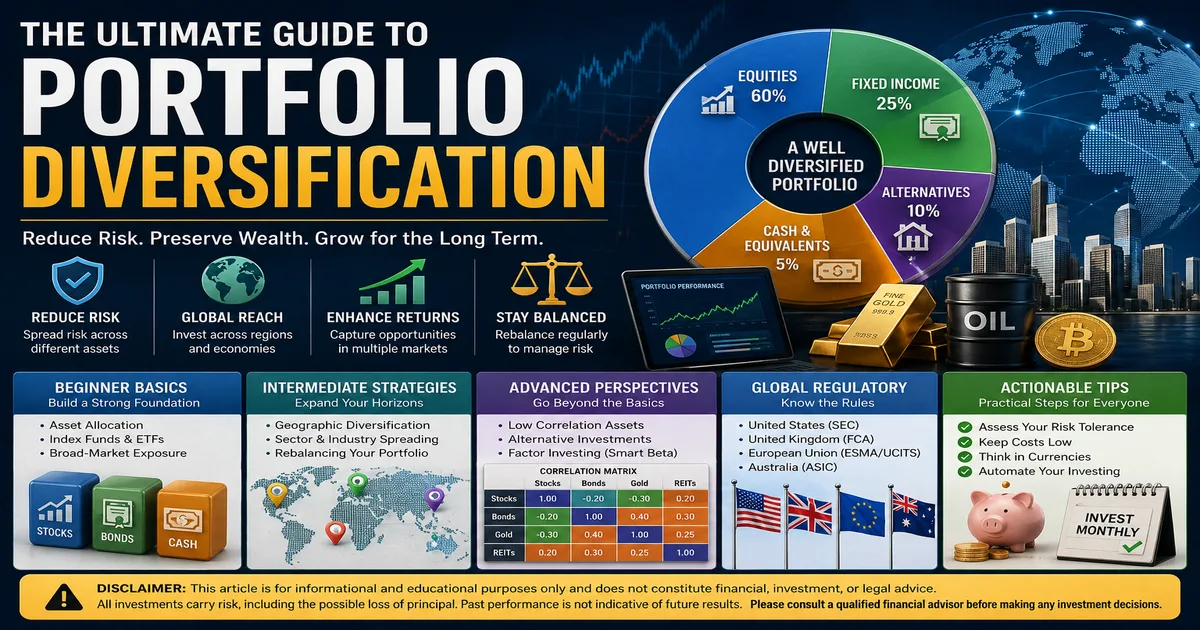
For those just starting, the most important decision is not which specific stock to buy, but how to allocate your capital across broad asset classes. The three primary buckets are:
- Equities (Stocks): Representing ownership in companies. These offer high growth potential but come with higher volatility.
- Fixed Income (Bonds): Essentially loans to governments or corporations. They provide regular interest payments (coupons) and are generally more stable than stocks.
- Cash and Equivalents: Including savings accounts, money market funds, and T-bills. These offer high liquidity and safety but often struggle to beat inflation.
The Power of Index Funds and ETFs
Beginners should focus on 'broad-market' diversification. Instead of picking one company like Apple or Nestlé, you can buy an Exchange-Traded Fund (ETF) that tracks a major index. For example, an S&P 500 ETF provides exposure to the 500 largest US companies, while an MSCI World ETF offers exposure to developed markets globally, including Europe and Japan. This immediately diversifies your 'unsystematic risk'—the risk that a single company might fail due to poor management or a specific scandal.
Intermediate Strategies: Expanding Horizons
Geographic Diversification
Many investors suffer from 'home bias,' where they over-invest in their own country's stock market. A truly diversified investment portfolio looks across borders. Consider allocating portions of your portfolio to:
- Developed Markets: Stable economies like the US (USD), Eurozone (EUR), and Japan (JPY).
- Emerging Markets: High-growth regions like India (INR), Brazil (BRL), and Southeast Asia. These carry higher political and currency risk but offer significant upside.
Sector and Industry Spreading
Even within a single stock market, you must diversify across sectors. The Global Industry Classification Standard (GICS) identifies 11 sectors, including Technology, Healthcare, Financials, and Energy. If your portfolio is 80% Technology, a regulatory crackdown on AI or a chip shortage could devastate your holdings. Aim for a mix of 'Cyclical' stocks (which thrive when the economy grows, like Consumer Discretionary) and 'Defensive' stocks (which stay stable, like Utilities and Healthcare).
Rebalancing Your Portfolio
Intermediate investors must understand the 'drift.' If your stocks perform exceptionally well, they might grow from 60% of your portfolio to 80%. This makes your portfolio riskier than intended. Periodic rebalancing—selling a portion of your winners to buy underperforming assets—forces you to 'buy low and sell high' and maintains your desired risk profile.
Advanced Perspectives: Institutional-Grade Construction
Correlation Coefficients and Modern Portfolio Theory (MPT)
Advanced investors use the correlation coefficient to measure how two assets move in relation to each other. A correlation of +1.0 means they move in perfect lockstep, while -1.0 means they move in opposite directions. The goal is to find assets with low or negative correlations. For instance, when stocks (equities) crash, gold or long-term government bonds often rise. By combining these, you smooth out the 'volatility curve' of your total wealth.
Alternative Investments
To further decouple from the standard stock/bond fluctuations, sophisticated portfolios include 'Alternatives':
- Real Estate (REITs): Providing rental income and inflation protection.
- Commodities: Oil, copper, and agricultural products that often hedge against geopolitical instability.
- Private Equity and Hedge Funds: Often reserved for 'Accredited Investors' under SEC (US) or FCA (UK) guidelines, these offer non-public market exposure.
- Digital Assets: While volatile, small allocations to Bitcoin are increasingly viewed by some institutional desks as a 'digital gold' hedge.
Factor Investing and Smart Beta
Beyond sectors, advanced investors look at 'factors'—characteristics that have historically driven returns. These include Value (undervalued stocks), Momentum (stocks trending upward), Quality (companies with strong balance sheets), and Low Volatility. Using 'Smart Beta' ETFs, you can tilt your portfolio toward these factors based on the current stage of the economic cycle.
Global Regulatory Considerations
Investing is not just about math; it is about the legal framework. Regulations vary significantly:
- United States: Governed by the SEC. Investors often use tax-advantaged accounts like 401(k)s or IRAs.
- United Kingdom: Regulated by the FCA. The 'ISA' (Individual Savings Account) allows for tax-free growth and diversification.
- European Union: Governed by ESMA and UCITS directives, ensuring high levels of investor protection and fund transparency across the bloc.
- Australia: Regulated by ASIC, with a heavy focus on the 'Superannuation' system for retirement diversification.
Actionable Tips for All Investors
- Assess Your Risk Tolerance: Before buying anything, determine how much of a drawdown (loss) you can stomach emotionally and financially.
- Keep Costs Low: High management fees (Expense Ratios) compound over time and can eat 20-30% of your long-term gains. Prefer low-cost ETFs.
- Think in Currencies: If you live in Europe but invest only in US stocks, you are taking a massive bet on the USD/EUR exchange rate. Consider currency-hedged funds if you want to eliminate this risk.
- Automate Your Investing: Use 'Dollar Cost Averaging' (DCA) to invest a fixed amount every month, regardless of market prices.
Conclusion
Building a diversified investment portfolio is a journey, not a one-time event. It begins with a solid foundation of low-cost index funds, expands into different geographies and sectors, and matures into a sophisticated blend of assets with low correlations. By adhering to global regulatory standards and maintaining a disciplined rebalancing schedule, you can protect your capital against the unpredictable nature of global markets. Remember, the goal of diversification isn't to maximize returns in a single year, but to ensure that you stay in the game long enough to reach your ultimate financial goals.
Comments
No comments yet. Be the first to share your thoughts!
Leave a Comment