
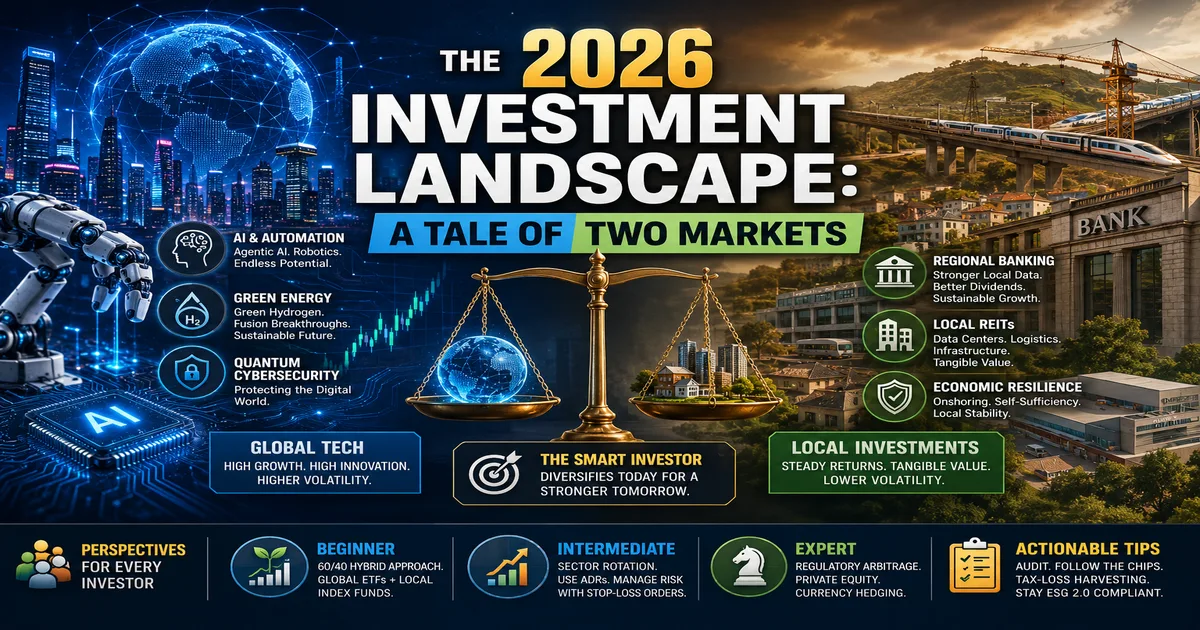
The 2026 Investment Landscape: A Tale of Two Markets
As we navigate the fiscal landscape of 2026, the global stock market has reached a fascinating crossroads. On one side, we see the meteoric rise of global technology trends—driven by mature Artificial Intelligence (AI), the commercialization of quantum computing, and the electrification of everything. On the other side, local investment options, such as regional infrastructure, domestic banking, and localized real estate, offer a sense of stability and tangible value in an increasingly digital world. For the modern investor, the challenge is no longer just picking a winning stock, but balancing the high-octane growth of Silicon Valley and Shenzhen with the grounded yields of their own backyard.
The Macro Environment: Why 2026 is Different
By 2026, the 'higher for longer' interest rate environment of the early 2020s has stabilized into a 'new normal.' Central banks like the Federal Reserve (Fed) and the European Central Bank (ECB) have found a precarious balance between inflation control and growth support. However, the primary driver of market volatility isn't just interest rates anymore; it is the divergence between globalized tech sectors and localized economic resilience. Investors are now forced to decide: do I chase the next $10 trillion tech breakthrough, or do I secure my wealth in local assets that are shielded from global supply chain shocks?
Section 1: The Dominant Global Tech Trends of 2026
1. AI-Driven Automation and Robotics
In 2026, AI has moved beyond chatbots. We are now in the era of 'Agentic AI'—autonomous systems that handle end-to-end business processes. Companies like NVIDIA, Alphabet, and specialized robotics firms in Japan are seeing unprecedented demand. For a global investor, this trend represents a high-growth opportunity. The market cap of the 'Magnificent Seven' has evolved, with some firms pivoting entirely toward hardware-as-a-service (HaaS).
2. The Green Hydrogen and Fusion Breakthroughs
Energy technology has taken center stage. Following the regulatory frameworks established by the EU Green Deal and the US Inflation Reduction Act, 2026 marks the first year where green hydrogen has become cost-competitive with natural gas in several industrial hubs. Investing in global energy giants that have successfully transitioned their portfolios is a key strategy for those looking at 10-year horizons.
3. Quantum Cybersecurity
With the threat of 'Q-Day' (the day quantum computers can break standard encryption) looming, cybersecurity has become a non-discretionary spend for every Fortune 500 company. Global tech stocks in the cybersecurity space are no longer speculative; they are the defensive plays of the tech world.
Section 2: The Resurgence of Local Investment Options
While global tech captures the headlines, local markets are proving their worth through resilience and 'onshoring' trends. As nations prioritize self-sufficiency, local investment options have become highly attractive.
1. Regional Banking and Fintech
In regions like Southeast Asia and Latin America, local banks are outperforming global giants by leveraging localized data. For instance, a bank regulated by the Monetary Authority of Singapore (MAS) or the Securities and Exchange Board of India (SEBI) may offer better dividends and growth prospects than a global conglomerate struggling with cross-border regulatory friction.
2. Localized Infrastructure and REITs
Real Estate Investment Trusts (REITs) focused on data centers and logistics hubs are the bridge between tech and local investing. As global tech companies expand their physical footprint, the local land and infrastructure owners are the primary beneficiaries. These assets are often denominated in local currency, providing a hedge against USD volatility.
Section 3: Perspectives for Every Level of Investor
The Beginner Perspective: The 'Hybrid' Index Approach
For those just starting in 2026, the complexity of picking individual tech stocks can be overwhelming. The best strategy is a 60/40 split. Allocate 60% of your portfolio to a global tech ETF (Exchange Traded Fund) to capture the upside of AI and Green Tech. The remaining 40% should go into a local 'Total Market' index fund. This ensures you benefit from global innovation while maintaining a base of local stability. Actionable Tip: Use fractional shares to build a diversified portfolio with as little as $100 or €100.
The Intermediate Perspective: Sector Rotation and ADRs
Intermediate investors should look at American Depositary Receipts (ADRs) to bridge the gap. If you live in Europe but want exposure to Asian tech, ADRs allow you to trade on familiar exchanges while accessing foreign growth. At this level, you should be monitoring the 'Beta' of your portfolio—ensuring that your local holdings aren't too closely correlated with global tech swings. Actionable Tip: Use 'Stop-Loss' orders to protect gains in volatile tech sectors while letting your local dividend-paying stocks compound over time.
The Expert Perspective: Regulatory Arbitrage and Private Equity
Advanced investors in 2026 are looking at the 'cracks' between regulations. For example, the difference in AI ethics regulations between the EU (ESMA) and the US (SEC) creates opportunities for arbitrage. Experts might also look at private equity in local tech startups that are preparing for an IPO. This requires a deep understanding of local liquidity requirements and tax treaties (such as the Avoidance of Double Taxation Agreements). Actionable Tip: Consider 'Currency Hedging' strategies to protect against the depreciation of your local currency relative to the USD or EUR when investing in global tech.
Section 4: Comparing the Two - A Practical Breakdown
- Volatility: Global tech is high-volatility, high-reward. Local investments are generally lower volatility but offer steady income through dividends.
- Liquidity: Global tech stocks (NASDAQ, NYSE) offer 24/7 liquidity. Local stocks in emerging markets may have 'thin' trading volumes, making it harder to exit large positions quickly.
- Regulatory Risk: Global tech faces antitrust lawsuits and data privacy fines. Local investments face localized political risk and changes in domestic tax law.
Actionable Investment Tips for 2026
- Audit Your Exposure: Once a quarter, check how much of your wealth is tied to the US Dollar. If it's more than 70%, look for local opportunities in your home currency.
- Follow the Chips: In 2026, semiconductor supply chains are the best indicator of tech health. If a local market is building a 'Fab' (semiconductor factory), that local market is a 'Buy'.
- Tax-Loss Harvesting: Use the volatility of global tech to offset the capital gains from your stable local investments.
- Stay Informed on ESG 2.0: In 2026, Environmental, Social, and Governance (ESG) standards are strictly enforced. Ensure your global tech picks are compliant to avoid 'Greenwashing' penalties.
Conclusion
In 2026, the most successful investors are those who refuse to choose between 'Global' and 'Local.' By leveraging the explosive growth of global tech trends like AI and Green Energy, while anchoring their portfolio in the tangible security of local infrastructure and banking, investors can create a 'weather-proof' financial future. Whether you are a beginner using an app to buy your first fractional share or an expert managing a complex multi-currency fund, the key remains the same: diversify, stay informed on regulations, and never ignore the value of the world right outside your window.
Comments
No comments yet. Be the first to share your thoughts!
Leave a Comment